Donut
The donut. Everyone who learns Blender makes one, which is exactly why it is worth showing: it is the first time the whole chain (modelling, sculpting, procedural materials, particle systems, lighting and compositing) has to work together on one object.
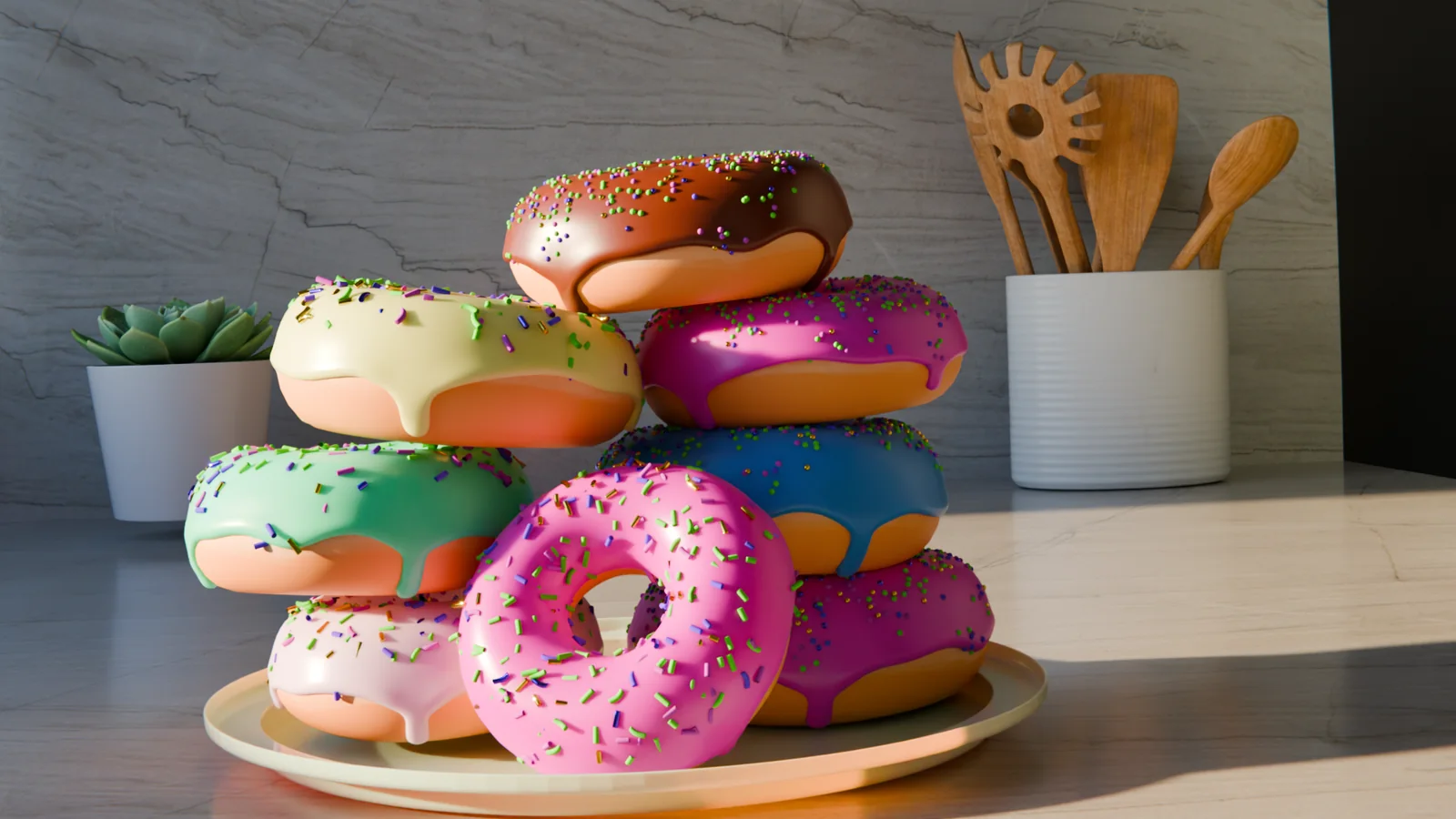
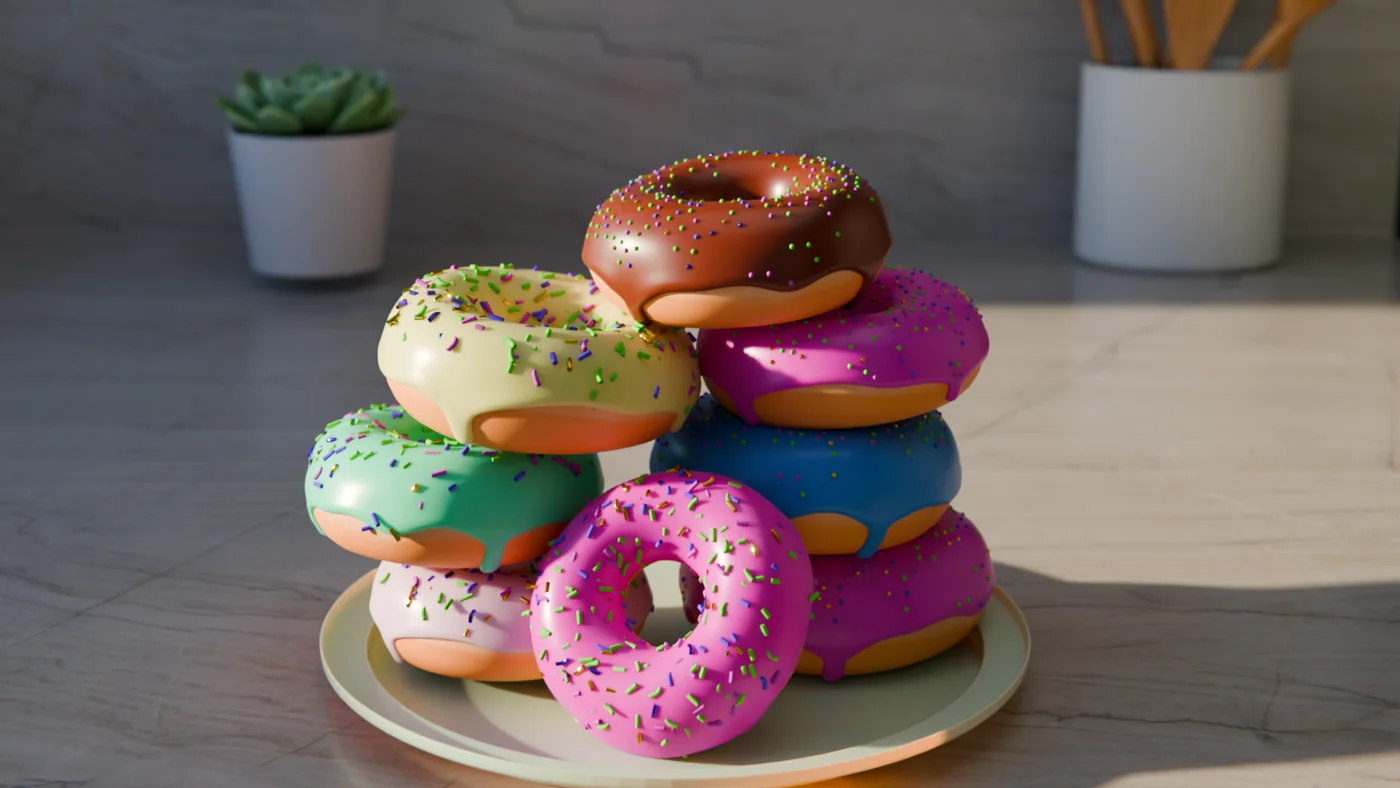
Why keep it in
It is where the fundamentals were learned, and the honest version of a 3D portfolio shows that. The useful part is not the donut, it is that every later piece of modelling rests on what this one forced into place.
What it actually exercises
The icing is a duplicated surface shrinkwrapped and solidified so it drips over the edge rather than floating on top. The sprinkles are a particle system scattered on that surface with randomised rotation and scale, weighted so they sit flat rather than spiking outward. Each glaze is one material with the colour driven separately, so seven donuts do not mean seven shader trees.
Lighting is the whole render
Hard directional light from the left throws the long shadow across the counter and gives the glaze its specular roll-off; the marble backdrop and the shallow depth of field do the rest. The props (succulent, utensil crock) exist to make the scale and the setting read as a kitchen rather than a grey void.
Highlights
- Icing built as a shrinkwrapped, solidified duplicate so the drip is geometry, not a texture.
- Sprinkles scattered by particle system with randomised rotation and scale, weighted to lie flat.
- Seven colourways from one material with the glaze colour driven per object.
- Hard key light for the specular roll-off on the glaze and the long counter shadow.
- Styled as a kitchen scene so the scale reads, with shallow depth of field on the backdrop.