Pollen
A local trend radar and AI studio for Instagram Reels. It ranks Reels by how far they beat their own creator's median rather than by raw views, transcribes the outliers and explains why they worked, turns the patterns into scripted ideas, and does all of it on one machine for nothing a month.
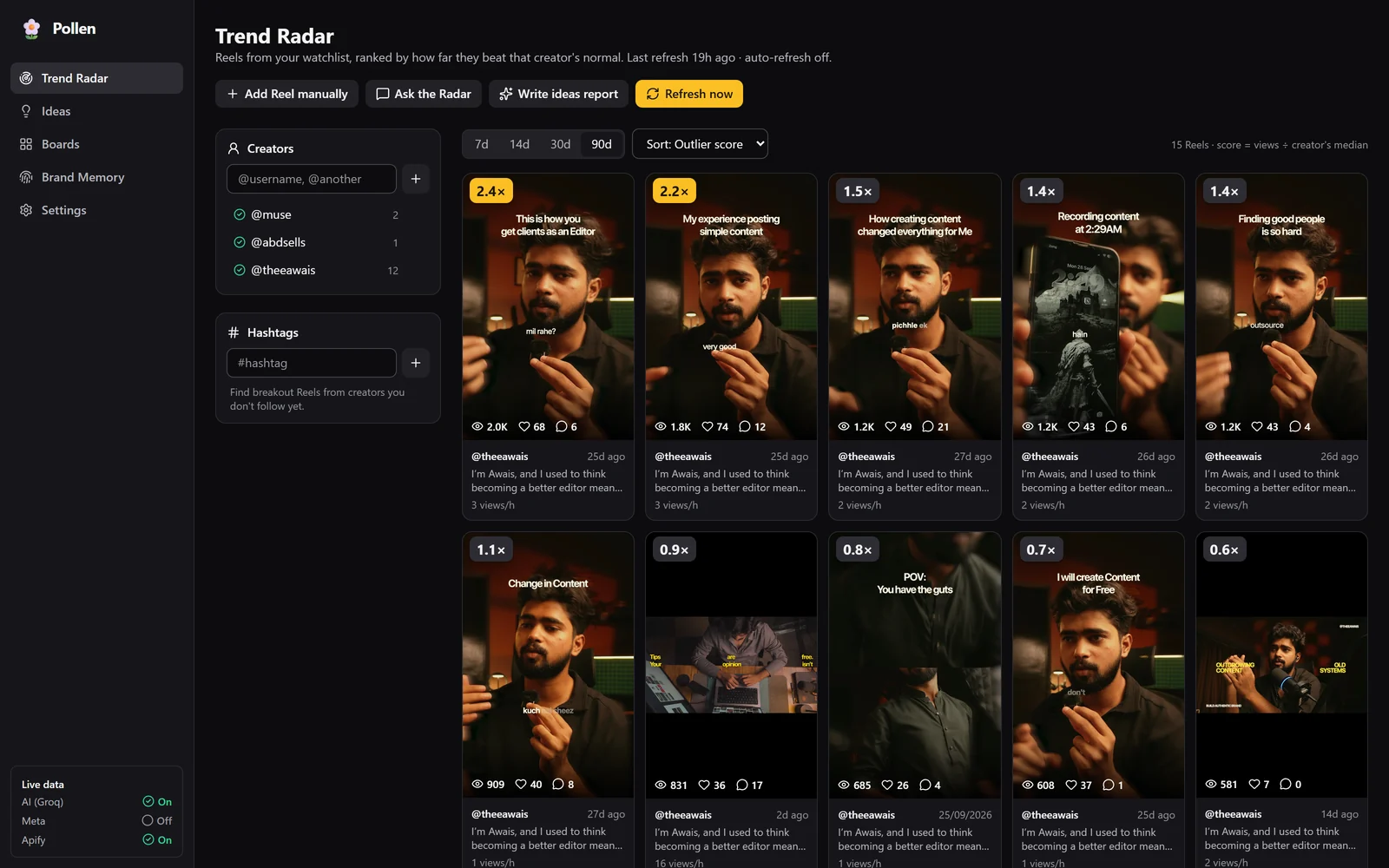
Views are a measure of the account, not the idea
A creator with two million followers taking 500K views has had a quiet day. A creator with two thousand taking 20K has had a breakout. Ranking a feed by views therefore sorts by audience size and surfaces the same large accounts every time, which tells you nothing you can act on. Pollen scores every Reel as its views divided by that creator's own median, so what floats to the top is the idea that outperformed its usual audience. That is the thing worth copying.
Refusing to score is a feature
A median is meaningless off two data points, so a creator needs at least three other Reels before Pollen will put a number on anything, and the median excludes the Reel being scored. Where that bar is not met the badge is simply absent rather than approximate. A tool like this earns its place by being trusted on the few numbers it does show, and one invented baseline would cost more credibility than a dozen missing badges.
Why it worked, not that it worked
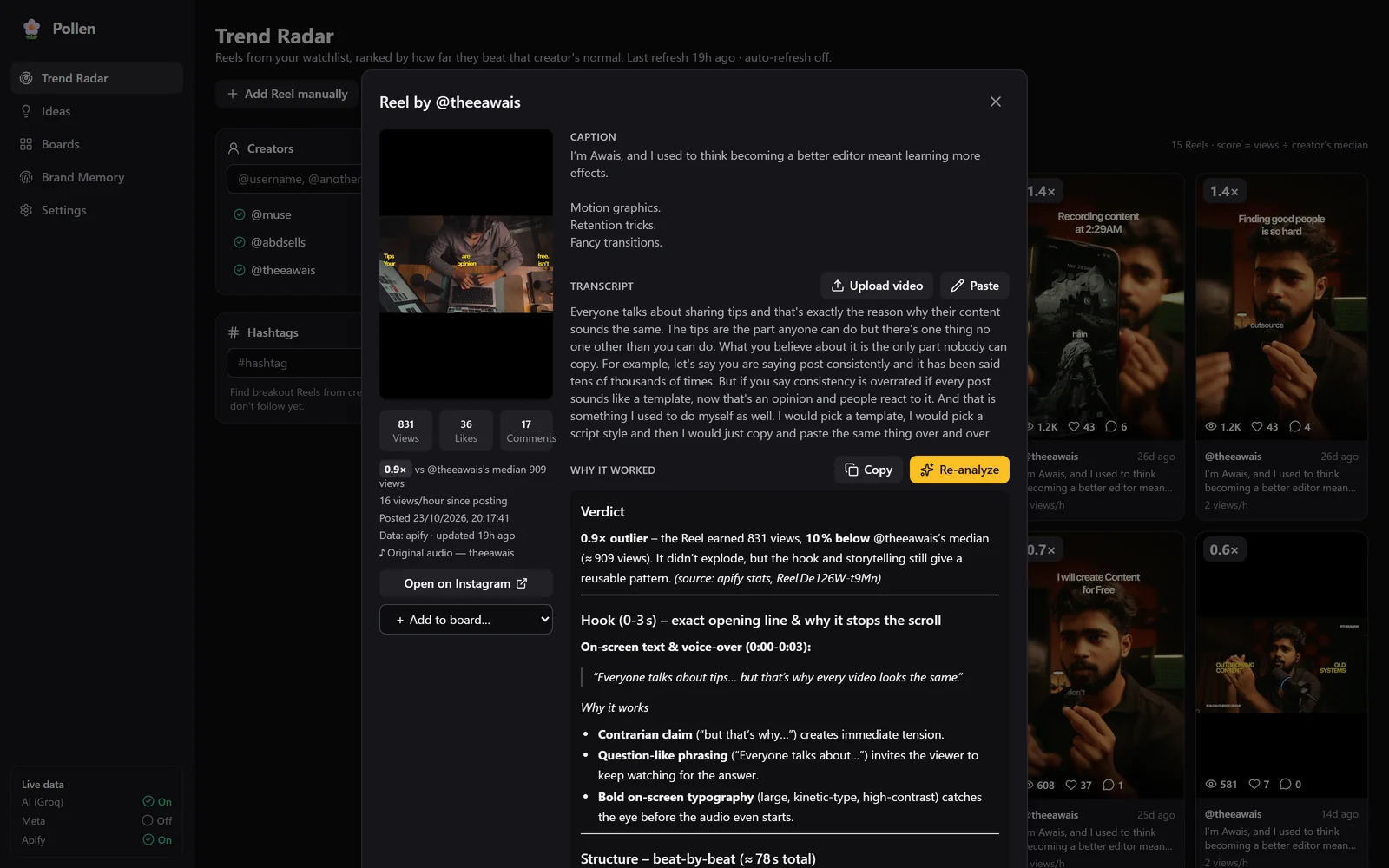
For the top outliers the audio is transcribed with Whisper and an LLM writes the breakdown: a one-line verdict against that creator's median, the hook in the first three seconds, and the beat-by-beat structure. The prompt is told exactly which numbers it has and where each came from, so it says it does not know rather than filling the gap. The Reel shown here scored 0.9x, an average performer, and the verdict says so; picking a winner would have made a better screenshot and a worse demonstration.
From a pattern to something to film
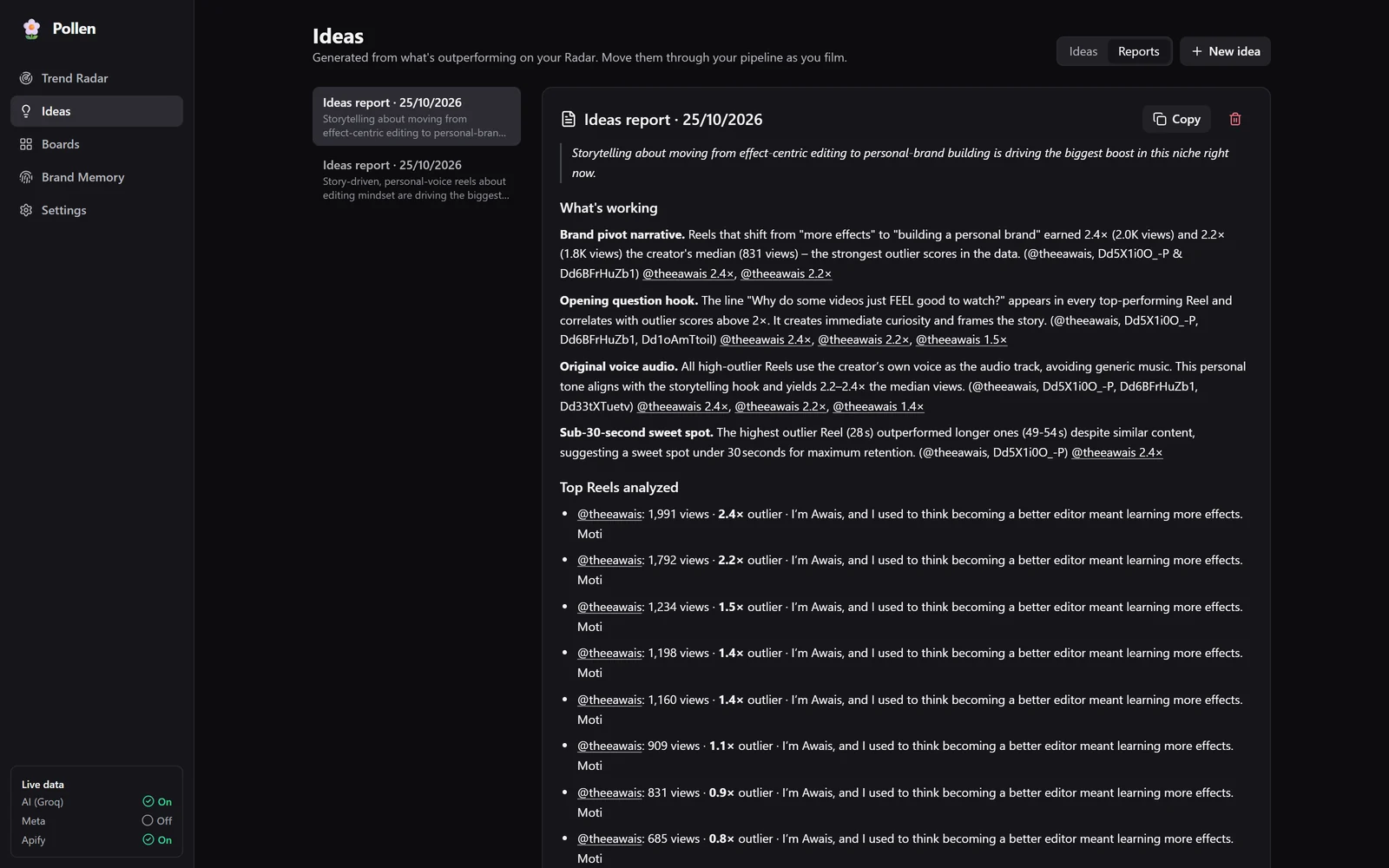
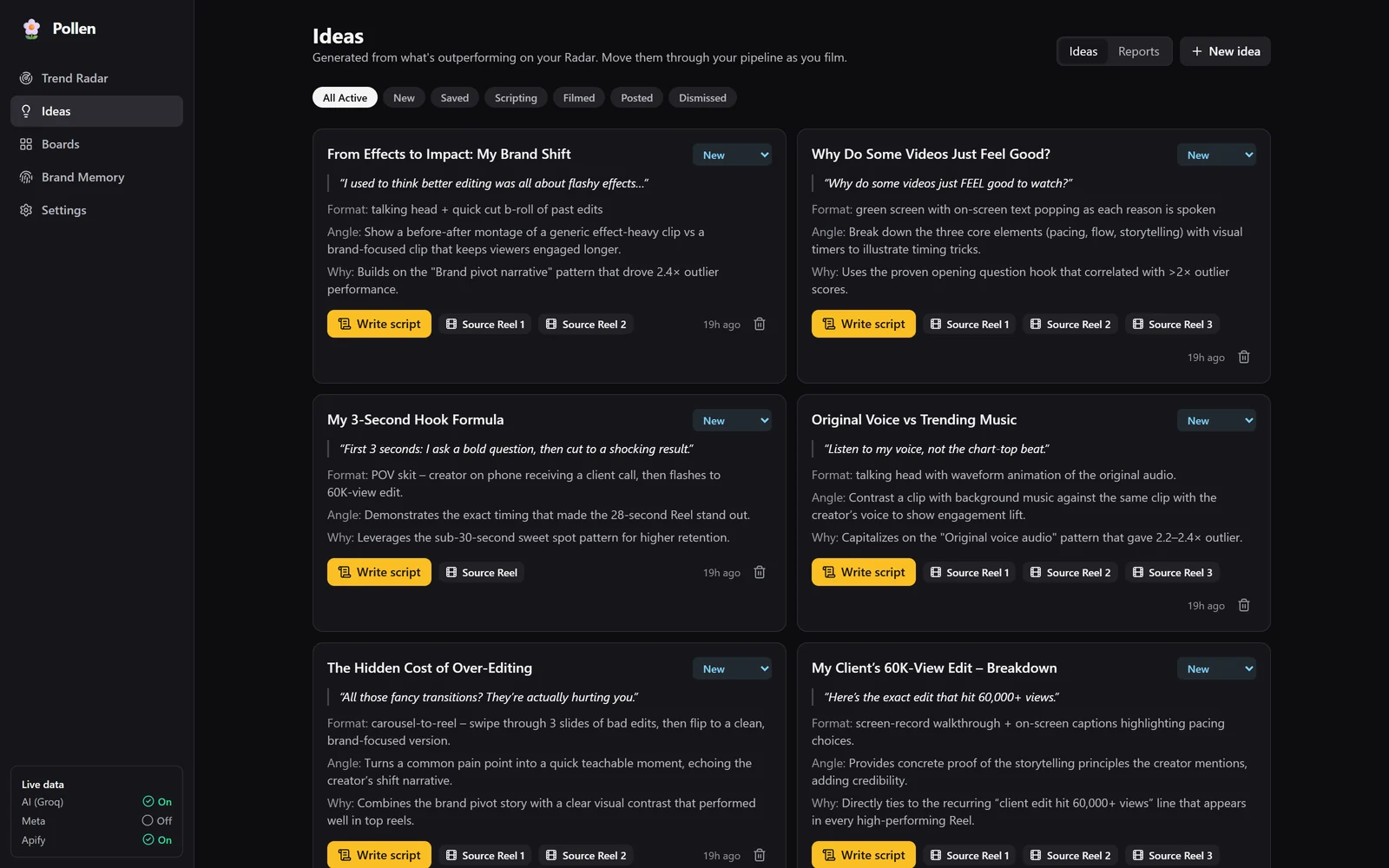
After each refresh an ideas report groups what is working into named patterns and cites the Reels behind each one, then produces ideas carrying a hook, a format, an angle and a reason, tuned to a stored brand memory. Ideas move through New, Scripting, Filmed and Posted, and any one of them expands into a timestamped script. The chain only pays off if it runs end to end: a pipeline that stops to ask a human what it meant is a slower spreadsheet.
A canvas you can wire into a conversation
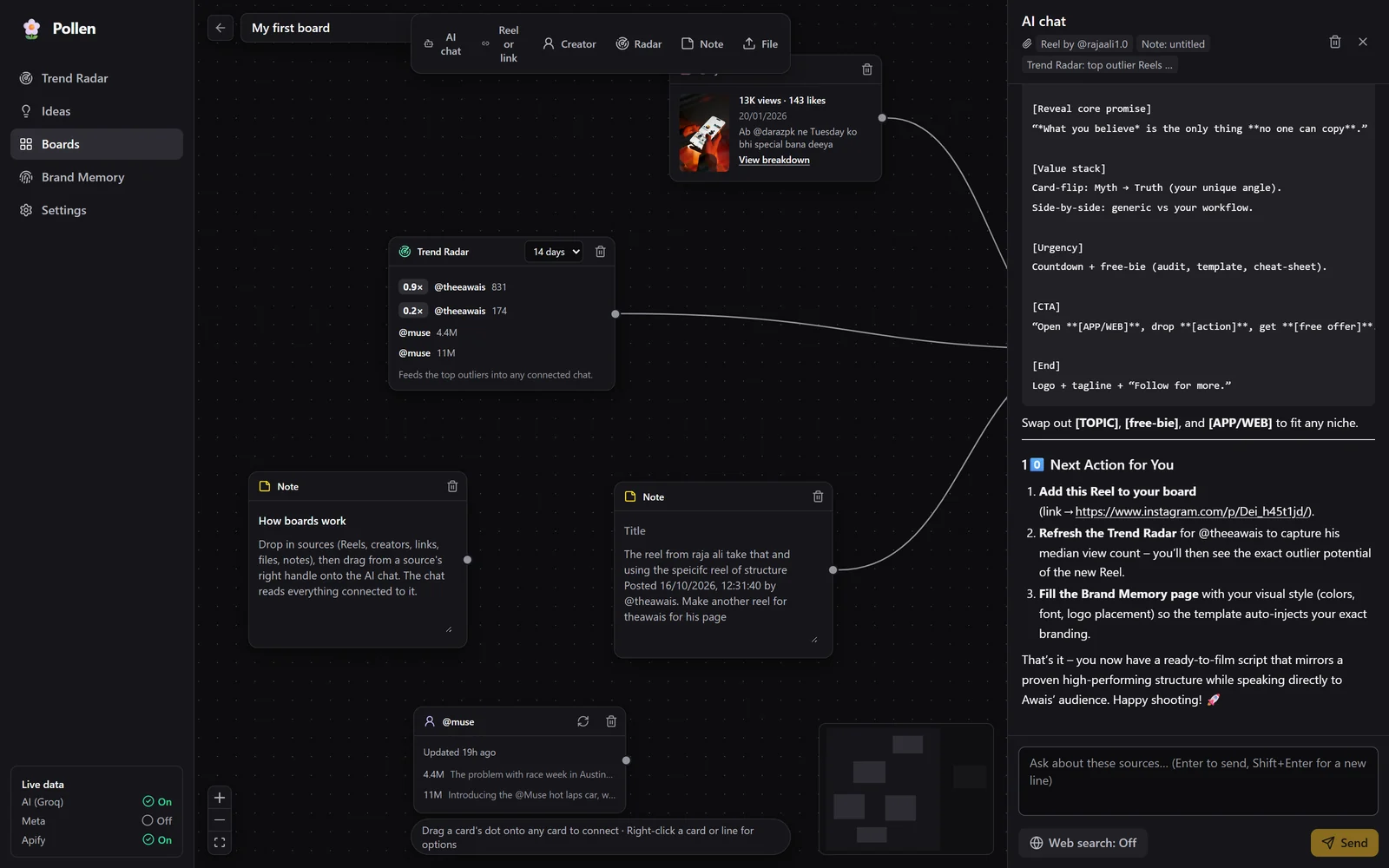
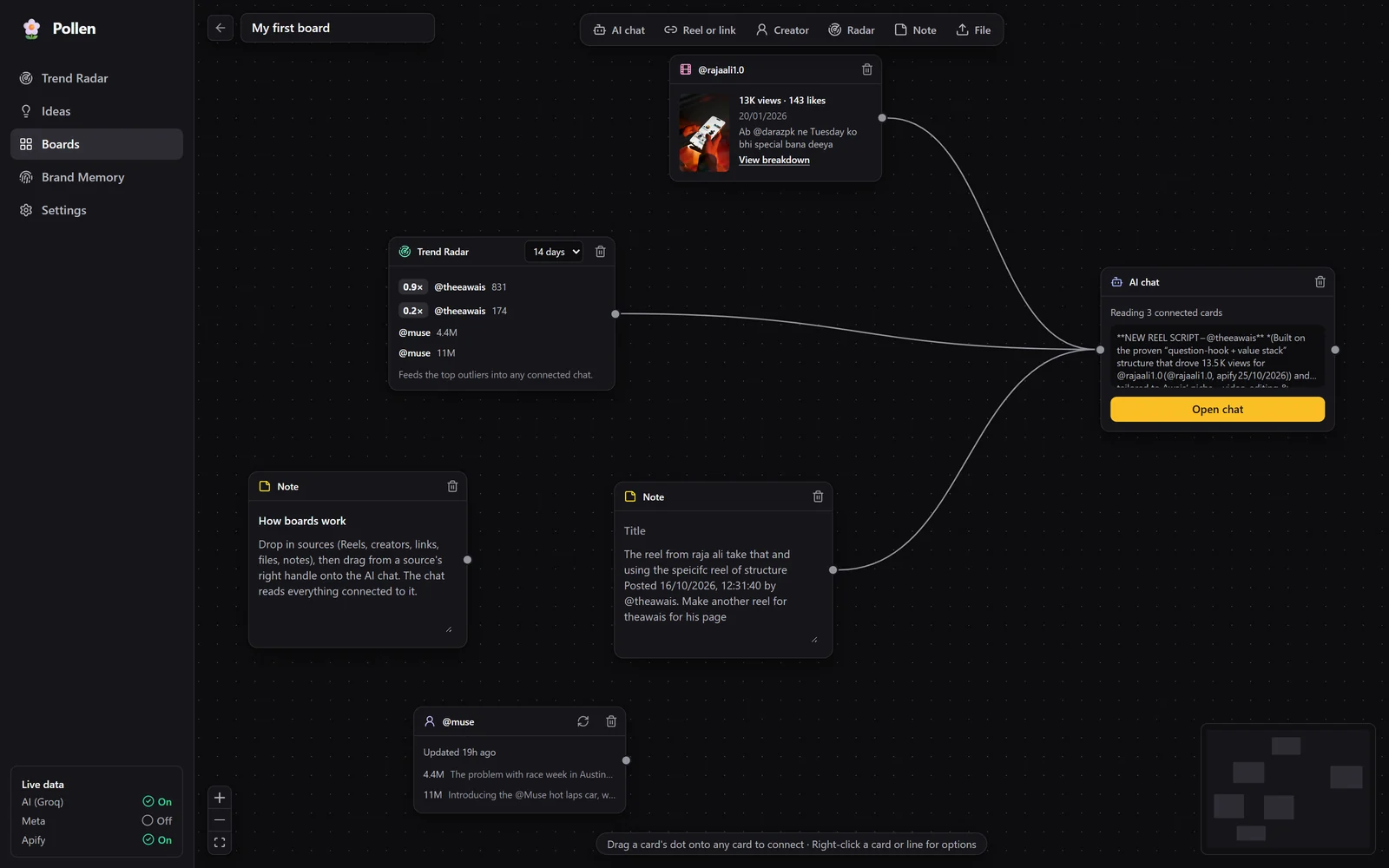
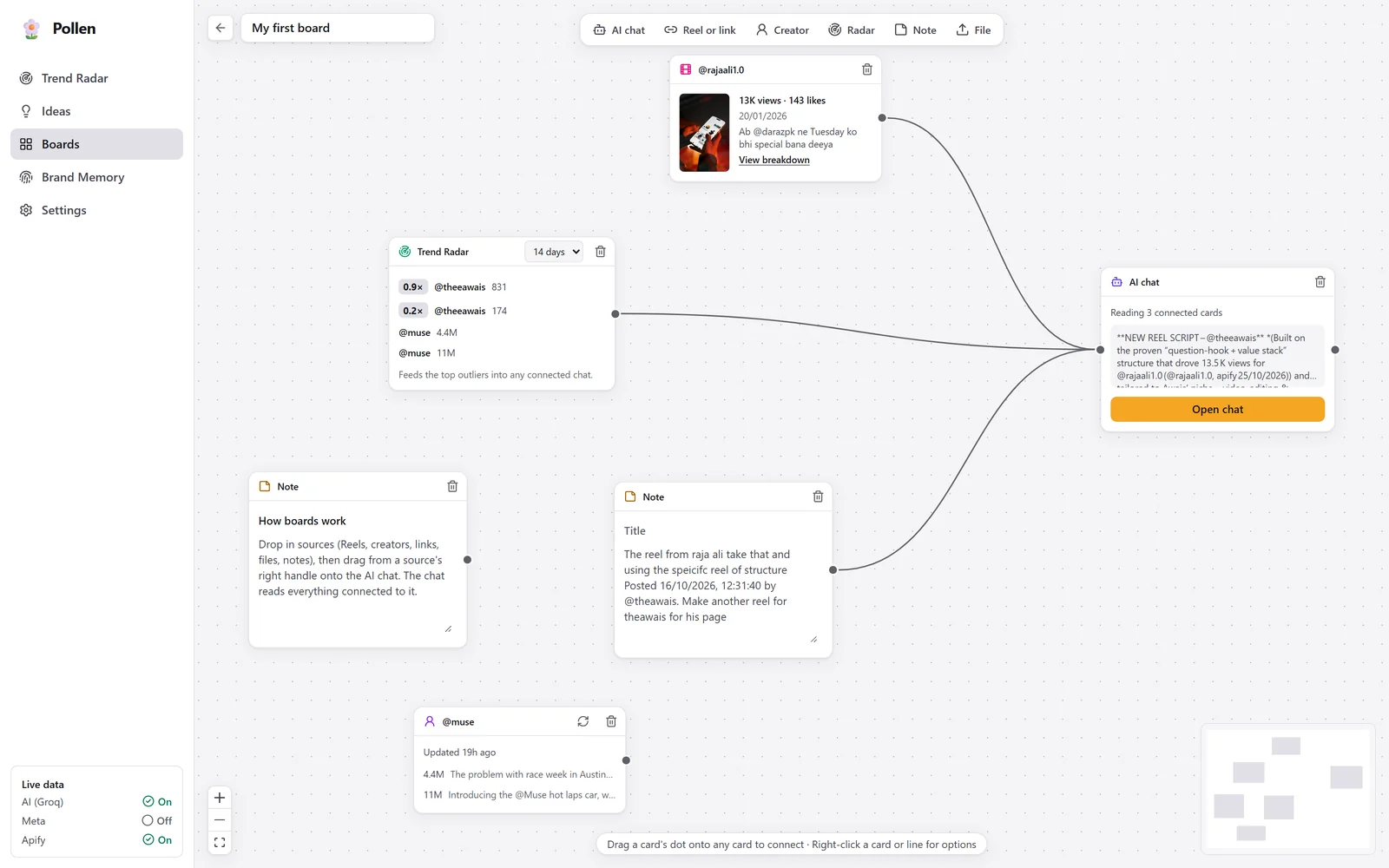
Boards are a React Flow canvas holding Reels, creators, the live radar, web pages, PDFs, audio and notes, any of which can be connected into an AI chat node. The chat reads only what is wired to it and the chips above the panel name exactly what that is, so the context is visible instead of implied. Dragging a line in or cutting one is how you change what the model knows.
Built to the shape of free tiers
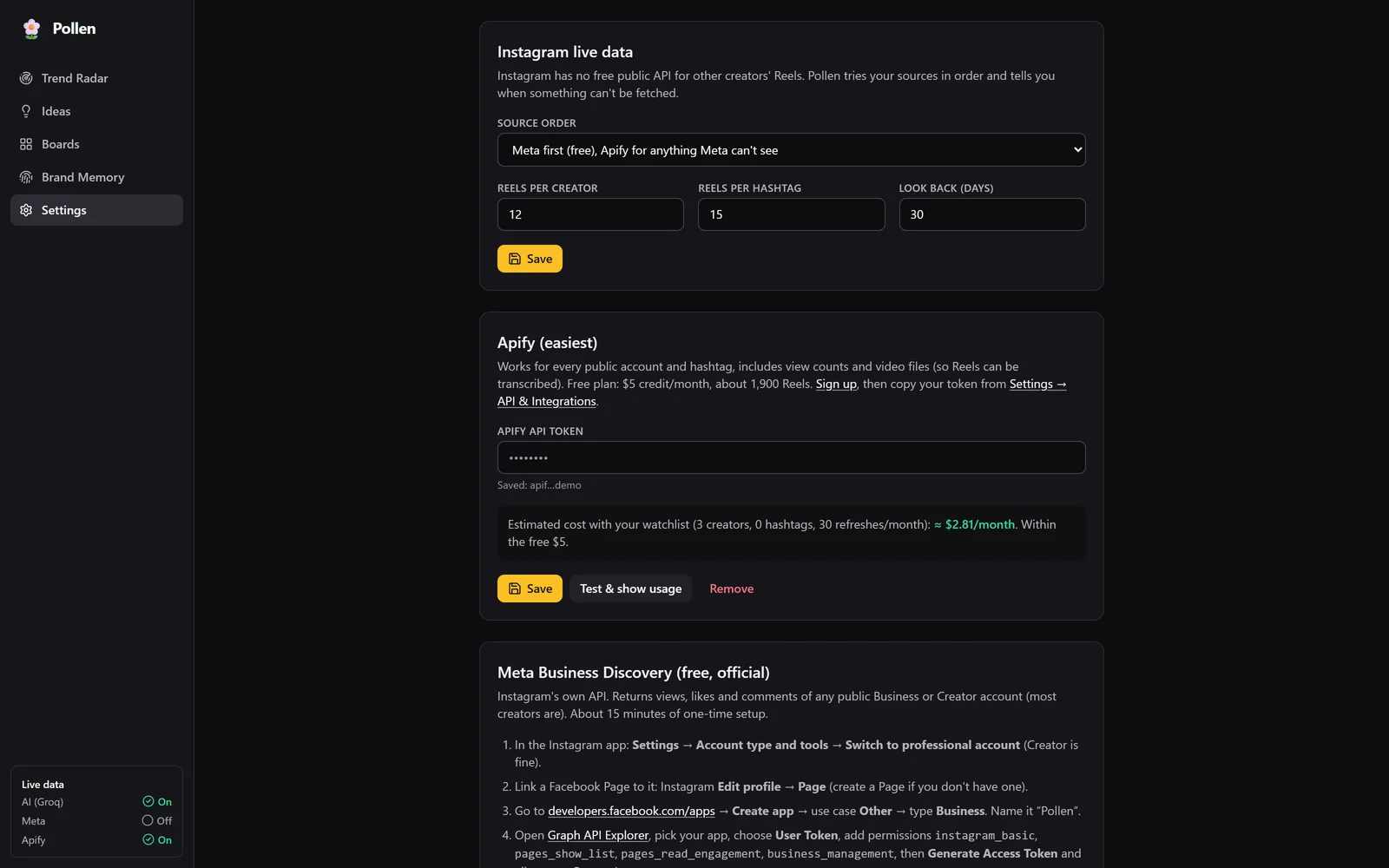
The data comes from a fallback chain, Meta Business Discovery first because it is official and free, then Apify on its monthly credit, then manual entry, and when a source cannot see something the interface says why and names the alternative. Settings estimates the monthly Apify spend from the size of the watchlist. Groq's rate limit is handled by trimming sources to a context budget, retrying short 429s on the header and failing over to a second model on long ones. Keys, Reels, transcripts and chats stay in one SQLite file on the machine.
Highlights
- Ranks Reels by views divided by their own creator's median, so the idea is what surfaces rather than the audience size.
- Declines to score at all below three baseline Reels: no badge rather than a misleading one.
- Whisper transcription plus an LLM breakdown naming the verdict, the hook and the structure.
- The model is told which numbers it holds and where they came from, so it can say it does not know.
- Ideas reports cite the Reels behind every pattern, and ideas expand into timestamped scripts.
- A React Flow board whose AI chat reads only the cards wired into it, shown as chips.
- Source fallback chain with a live cost estimate, rate-limit handling and model failover.
- Local-first: one SQLite file, keys masked before they reach the browser.
Screenshots are the real app on real local data; nothing is mocked and no figure was edited. The Reels, thumbnails and handles in frame belong to their respective public creators and appear only to show what the tool analyses, not as my own work. API keys were swapped for dummy values in a copy of the database before capture, so no real key is visible. Two known quirks, both real behaviour: in the ideas report the model restates a baseline slightly different from the one the radar computes, which is why the report prompt should be handed the computed median as a fixed fact; and the board toolbar wraps when the chat panel is open at this width.